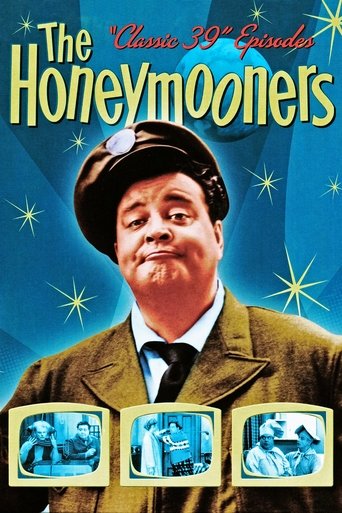
เรื่องย่อและรีวิว The Honeymooners
The Honeymooners เป็นซีรี่ย์ฝรั่ง ปี 1955
A bus driver and his sewer worker friend struggle to strike it rich while their wives look on with weary patience. One of the most influential situation comedy television series in American history.
เจาะลึก The Honeymooners: เนื้อเรื่อง การสร้าง และเสียงวิจารณ์
The Honeymooners is an American television sitcom that originally aired from 1955 to 1956, created by and starring Jackie Gleason, and based on a recurring comedy sketch of the same name that had been part of Gleason's variety show. It follows the lives of New York City bus driver Ralph Kramden (Gleason), his wife Alice (Audrey Meadows), Ralph's best friend Ed Norton (Art Carney) and Ed's wife Trixie (Joyce Randolph) as they get involved with various schemes in their day-to-day living.
Most episodes revolve around Ralph's poor choices in absurd dilemmas that frequently show his judgmental attitude in a comedic tone. The show occasionally features more serious issues such as women's rights and social status.
The original comedy sketches first aired on the DuMont network's variety series Cavalcade of Stars, which Gleason hosted, and subsequently on the CBS network's The Jackie Gleason Show, which was broadcast live in front of a theater audience. The popularity of the sketches led Gleason to rework The Honeymooners as a filmed half-hour series, which debuted on CBS on October 1, 1955, replacing the variety series. It was initially a ratings success as the No. 2 show in the United States, facing stiff competition from The Perry Como Show on NBC. Gleason's show eventually dropped to No. 19, and production ended after 39 episodes (now referred to as the "Classic 39 episodes").
The final episode of The Honeymooners aired on September 22, 1956, and Gleason sporadically revived the characters until 1978. The Honeymooners was one of the first American television shows to portray working-class married couples in a gritty, non-idyllic manner, as the show is mostly set in the Kramdens' kitchen in a neglected Brooklyn apartment building. One of the sponsors of the show was Buick.
Cast and characters
The majority of The Honeymooners episodes focus on four principal characters and generally use fixed sets within their Brooklyn apartment building. Although various secondary characters make multiple appearances, and occasional exterior shots are incorporated during editing, virtually all action and dialogue is "on stage" inside the normal backdrop.
Ralph Kramden
Played by Jackie Gleason, a bus driver for the fictional Gotham Bus Company based in New York City, he is never seen driving a bus (except in publicity photos), but sometimes is shown at the bus depot. Ralph is frustrated by his lack of success and often develops get-rich-quick schemes. He is short-tempered, frequently resorting to bellowing, insults, and hollow threats. The show's other characters have his weight as an easy target for the insults that they throw back at him. Well-hidden beneath the many layers of bluster, however, is a softhearted man who loves his wife and is devoted to his best friend, Ed Norton. Ralph enjoys bowling and playing pool; he is proficient at both and is an enthusiastic member of the Loyal Order of Raccoons (although in several episodes, a blackboard at the lodge lists his dues as being in arrears). Ralph's mother rarely is mentioned, although she appears in one episode. Ralph's father is mentioned in only one episode ("Young Man with a Horn") as having given Ralph a cornet he learned to play as a boy, and Ralph insists on keeping the cornet when Alice suggests it be thrown away.
The Ralph Kramden character was given honorary membership in the real New York City bus drivers' union (Local 100 of the Transport Workers Union) during the run of the show, and a Brooklyn bus depot was named in Gleason's honor after his death. Ralph Kramden was the inspiration for the animated character Fred Flintstone. An eight-foot-tall bronze statue of a jolly Jackie Gleason in a bus driver's uniform was erected in 1999 in front of Manhattan's midtown Port Authority Bus Terminal. TV Land funded the statue in cooperation with Gleason's estate and the Port Authority. Also in 1999, Ralph was ranked #13 on TV Guide's list of the 50 greatest TV characters.
Alice Kramden
Alice (née Alice Gibson), played in the first nine skits from 1951 to January 1952 by Pert Kelton, by Audrey Meadows until 1956, then by Sheila MacRae, is Ralph's patient but sharp-tongued wife of 14 years. She often finds herself bearing the brunt of Ralph's tantrums and demands, which she returns with biting sarcasm. She is levelheaded, in contrast to Ralph's pattern of inventing various schemes to enhance his wealth or his pride. She sees his schemes' unworkability, but he becomes angry and ignores her advice (and by the end of the episode, her misgivings almost always prove correct). Upon discovering the failures of his schemes and subsequent cover-ups, she demands to Ralph: "Oh, how I wish you had an explanation for that." Alice runs the finances of the Kramden household, and Ralph frequently has to beg her for money to pay for his lodge dues or crazy schemes. Alice studied to be a secretary before her marriage and works briefly in that capacity when Ralph is laid off. Wilma Flintstone is based on Alice Kramden.
Another foil for Ralph is Alice's mother, who is even sharper-tongued than her daughter and despises Ralph as a bad provider. Alice's father is occasionally mentioned, but never seen. Alice's sister Agnes appears in episode 22, "Here Comes the Bride". (Ralph jeopardizes his newlywed sister-in-law's marriage after giving some bad advice to the groom, but it all works out in the end). Ralph and Alice lived with her mother for six years after getting married before they got their own apartment. In a 1967 revival, Ralph refers to Alice (played by MacRae in 1966–70 and once more in 1973) as being one of 12 children, and to her father as never working.
The Honeymooners originally appeared as a sketch on the DuMont Network's Cavalcade of Stars, with the role of Alice played by Pert Kelton (1907–1968). When his contract with DuMont expired, Gleason moved to the CBS network where he had The Jackie Gleason Show, and the role of Alice went to Audrey Meadows because Kelton had been blacklisted. According to playwright Arthur Miller, a family friend, writing many years later in his autobiography Timebends: A Life, extensive inquiries finally revealed that her blacklisting was due to the fact that her husband Ralph had, many years earlier, marched in a May Day parade. "Ralph, I knew, had absolutely no leftist connections whatever but had simply thrown himself in with a gang of actors protesting whatever it was that year, and Pert had never even voted in her life."
The character's name is mentioned in the 1998 American stoner comedy film Half Baked in the lyrics to the song by the movie's character "Sir Smoka-Alot".
Edward Lillywhite/Ethelbert "Ed" Norton
Played by Art Carney; a New York City municipal sewer worker and Ralph's best friend (and upstairs neighbor). He is considerably more good-natured than Ralph, but nonetheless trades insults with him on a regular basis. Ed (typically called "Norton" by Ralph and sometimes by his own wife, Trixie) often gets mixed up in Ralph's schemes. His carefree and rather dimwitted nature usually results in raising Ralph's ire, while Ralph often showers him with verbal abuse and throws him out of the apartment when Ed irritates him. In most episodes, Ed is shown to be better-read, better-liked, more worldly and more even-tempered than Ralph, despite his unassuming manner and the fact that he usually lets Ralph take the lead in their escapades. Ed and Ralph both are members of the fictional Raccoon Lodge. Like Ralph, Ed enjoys and is good at bowling and playing pool. Unlike Ralph, Ed is good at ping-pong.
Ed worked for the New York City sewer department, and described his job as a "Sub-supervisor in the sub-division of the department of subterranean sanitation, I just keep things moving along." He served in the U.S. Navy in World War II, and used his G.I. Bill money to pay for typing school, but felt he was unable to work in an office because he hated working in confined spaces. The relatively few scenes set in the Norton apartment showed it to have the same layout as the Kramdens' but more nicely furnished. Though Norton makes the same weekly $62 salary as Ralph (roughly $750 in 2025 dollars), their higher standard of living might be explained by Norton's freer use of credit; at one point he admits to having 19 charge accounts.
Ed is the inspiration for Barney Rubble in The Flintstones, and for Yogi Bear (in terms of design, clothing, and mannerisms). In 1999, TV Guide ranked him 2nd on its list of the "50 Greatest TV Characters of All Time". According to Entertainment Weekly, Norton is ranked 8th of the "greatest sidekicks ever".
Thelma "Trixie" Norton
Thelma "Trixie" Norton was Ed's wife and Alice's best friend. She did not appear in every episode and had a less developed character, though she is shown to be somewhat bossy toward her husband. In one episode, she surprisingly is depicted as a pool hustler. Trixie is the inspiration for Betty Rubble in The Flintstones.
Elaine Stritch was the first and original Trixie Norton in a Honeymooners sketch ("The New Television") with Gleason, Carney, and Pert Kelton. Trixie's abrasive ex-burlesque-dancer character was rewritten and recast by Gleason after just one episode, with Joyce Randolph playing the character as a wholesome housewife.
Joyce Randolph played the role in earlier sketches and on the 1955–1956 sitcom The Honeymooners.
Jane Kean played the role in a series of hour-long Honeymooners episodes, in color and with music, on The Jackie Gleason Show from 1966 to 1970, playing the role for many more years than her predecessor.
Others
Some of the actors who appeared multiple times on the show include George O. Petrie and Frank Marth as various characters, Ethel Owen as Alice's mother, Zamah Cunningham as apartment building neighbor Mrs. Manicotti, and Cliff Hall as the Raccoon Lodge president.
Ronnie Burns, son of George Burns and Gracie Allen, made a guest appearance on one episode. On another episode, Norton makes a reference to a co-worker "Nat Birnbaum" (as in "'nat', a three-letter word for bug", says crossword puzzle aficionado Norton). George Burns's real name was Nathan Birnbaum. Seasoned actress Eileen Heckart appeared as Alice's mother in the 1978 The Honeymooners Christmas special (who was in reality just three years older than her "daughter", Alice). Strangely, Heckart's character makes several comments in the episode alluding to her desire to become a grandmother by Ralph and Alice, this despite the fact that Meadows, who played Alice, was in fact 55 years old at that time.
The apartment house
The Kramdens and Nortons lived in an apartment house at 328 Chauncey Street in Brooklyn, New York City, in an area known as "Bushwick" – a nod to the fact that Jackie Gleason lived there after his family moved from his birthplace at 364 Chauncey Street. In the 1955 episode "A Woman's Work is Never Done", the address is referred to as 728 Chauncey Street. The landlord of the apartment house is Mr. Johnson. In The Honeymooners episodes taped from 1967 to 1970, the address of the apartment house changed to 358 Chauncey Street, and the number of the Kramden apartment is 3B. The actual 328 Chauncey Street is located in the Stuyvesant Heights section of the borough, approximately eight miles northeast of the show's fictional location.
Apartment residents
Mr. and Mrs. Manicotti: An older couple of Italian descent.
Tyler: Older gentleman who lives on the same floor, who knocks out Ralph's fighter – “Dynamite” for waking him up while he [Dynamite] works out on the punching / speed bag.
Tommy Manicotti: He played stickball and contracted the measles. He also left his water pistol in the Kramdens' apartment.
Garrity: A vocal upstairs neighbor with whom Ralph frequently feuds. He fought with Ralph for disturbing the neighbors with practicing for The $99,000 Answer quiz show. But showing some humor in other episodes, he accused Ralph of renting the tuxedo for his sister-in-law's wedding from an undertaker, and loved Ralph's joke about "sending a knight out on a dog like this."
Garrity Boy: He played stickball and contracted the measles.
Mrs. Bennett: Needed her radiator fixed when Ralph was the janitor.
Johnny Bennett: He played stickball, earned an apple for a home-run—and contracted the measles like the other boys.
Mrs. Doyle: Mother of Tommy Doyle.
Tommy Doyle: He was arrested for spending a $100 counterfeit bill that Ralph gave him to take his suits to the cleaners.
Mrs. Stevens: She gave Alice a box for hairpins that was made of matchsticks for Christmas which was the same exact gift Ralph was about to give her but he vastly overpaid for it and thought he had a great gift rather than an insignificant trinket for Alice. Alice gave Mrs. Stevens a kitchen thermometer.
Mrs. Olsen: She said that Ralph broke her Venetian blinds instead of repairing them when Ralph temporarily was the building janitor.
Mrs. Hannah: Needed her bathtub fixed when Ralph was the janitor.
Mrs. Fogerty: Accused Ralph of taking food out of her ice box when Ralph was the janitor.
Mrs. Schwartz: The apartment house blabbermouth who reported that the Kramdens had set the all-time lowest gas bill for the building. She also was curious to know if the house phone was able to connect to New Jersey when Ralph was the janitor.
Mr. Riley: Had a full garbage can that needed to be emptied when Ralph was the janitor.
Judy Connors: A teenager who did not want her father to meet a boy named Wallace, her date.
Tommy Mullins: A U.S. Navy service member who was home on leave for Christmas.
Carlos Sanchez: A mambo dancer who works at night.
Mr. and Mrs. August Gunther: Former residents of the building. August hit it big with his doughnut business.
Mr. Johnson: The building's landlord.
Plot
Most of The Honeymooners takes place in Ralph and Alice Kramden's small, sparsely furnished two-room apartment. Other settings used in the show included the Gotham Bus Company depot, the Raccoon Lodge, a neighborhood pool parlor, a park bench where Ralph and Ed occasionally meet for lunch, and on occasion the Nortons' apartment (always noticeably better-furnished than the Kramdens'). Many episodes begin with a shot of Alice in the apartment awaiting Ralph's arrival from work. Most episodes focus on Ralph's and Ed's characters, although Alice played a substantial role. Trixie played a smaller role in the series, and did not appear in every episode as did the other three. Each episode presented a self-contained story, which rarely carried over into a subsequent one. The show employed a number of standard sitcom clichés and plots, particularly those of jealousy, get-rich-quick schemes, and comic misunderstanding.
As to the occasional plot continuations, there were two such sequences — one concerning Ralph being sent to a psychiatrist because of "impatient" behavior during work that resulted in several passengers lodging complaints about his professional demeanor, and one that continued for two sequential shows in which Aunt Ethel visited and Ralph hatched a scheme to marry her off to the neighborhood butcher.
The series presents Ralph as an everyman and an underdog who struggles to make a better life for himself and his wife, but who ultimately fails due to his own shortcomings. He, often along with Ed, devises a number of get-rich-quick schemes, none of which succeed. Ralph would be quick to blame others for his misfortune until it was pointed out to him where he had fallen short. Ralph's anger then would be replaced by short-lived remorse, and he would apologize for his actions. Many of these apologies to Alice ended with Ralph saying in a heartfelt manner, "Baby, you're the greatest," followed by a hug and kiss.
In most episodes, Ralph's short temper got the best of him, leading him to yell at others and to threaten comical physical violence, usually against Alice. Ralph's favorite threats to her were "One of these days … One of these days … Pow! right in the kisser!" or to knock her "to the Moon, Alice!" (Sometimes this last threat was simply abbreviated: as "Bang, zoom!") On other occasions, Ralph simply told Alice, "Oh, are you gonna get yours." All of this led to criticism, more than 40 years later, that the show displayed an ironic acceptance of domestic violence. But Ralph never carried out his threats, and others have pointed out that Alice knew he never would because of their deep love for each other — indeed, Alice never was seen to back down during any of Ralph's tirades. In retaliation, the targets of Ralph's verbal abuse often responded by simply joking about his weight, a common theme throughout the series.
For the "Classic 39" episodes of The Honeymooners, there was no continuing story arc. Each episode is self-contained. For example, in the series premiere episode "TV or Not TV", Ralph and Norton buy a television set with the intent to share it. By the next week's show, the set is gone although in later episodes a set is shown in the Nortons' apartment. In the installment "The Baby Sitter", the Kramdens get a telephone, but in the next episode, it is gone. And, in the episode, "A Dog's Life", Alice gets a dog from the pound which Ralph tries to return. But, in the end, Ralph finds himself growing to love the dog and decides to keep it along with a few other dogs. However, in the next episode, the dogs are nowhere to be seen and are never referred to again.
Occasionally, references to earlier episodes were made, including to Ralph's various "crazy harebrained schemes" from the lost episodes. Norton's sleepwalking in "The Sleepwalker" was referenced in "Oh My Aching Back", but it was not until the 1967 "Trip To Europe" shows that a Honeymooners story arc is finally used.
Origins
In July 1950, Jackie Gleason became the host of Cavalcade of Stars, a variety show that aired on the struggling DuMont Television Network. After the first year, he and his writers Harry Crane and Joe Bigelow developed a sketch that drew upon familiar domestic situations for its material. Based on the popular radio show The Bickersons, Gleason wanted a realistic portrayal of life for a poor husband and wife living in Brooklyn, his home borough. The couple would continually argue but ultimately show their love for each other. After rejecting titles such as "The Beast", "The Lovers" and "The Couple Next Door", Gleason and his staff settled on "The Honeymooners". Gleason took the role of Ralph Kramden, a blustery bus driver, and he chose veteran comedy film actress Pert Kelton for the role of Alice Kramden, Ralph's acerbic and long-suffering wife.
"The Honeymooners" debuted on October 5, 1951, as a six-minute sketch. Ensemble cast member Art Carney made a brief appearance as a police officer who is hit with flour that Ralph throws from the window. The tone of these early sketches was much darker than that of the later series, with Ralph exhibiting great bitterness and frustration with his marriage to an equally bitter and argumentative middle-aged woman (Kelton was nine years older than was Gleason). The Kramdens' financial struggles mirrored those of Gleason's early life in Brooklyn, and he took great pains to model the set on his memory of the apartment where he had lived. The Kramdens—and later the Nortons when those characters were added—are childless, an issue only occasionally explored, but a condition upon which Gleason insisted. Ralph and Alice did legally adopt a baby girl whom they named Ralphina. However, the biological mother requested to have her baby returned. A few later sketches had Ralph mistakenly believe that Alice was pregnant. A running theme on the series was Alice's longing to have a dog but Ralph refusing, a metaphor over the couple's dispute about having children (the ideas were picked up in the Flintstones).
Early cast additions in later sketches were upstairs neighbors Ed and Trixie Norton. Ed was a sewer worker and Ralph's best friend, although his innocent and guileless nature was the source of many arguments between the two men. Trixie (maiden name never mentioned), Ed's wife, was originally portrayed by Elaine Stritch as a burlesque dancer, but was replaced after just one appearance by the more wholesome-looking Joyce Randolph. Trixie is a foil to Ed, just as Alice is to Ralph, but often offscreen.
With the colorful array of characters whom Gleason had invented, including the cast of "The Honeymooners" sketches, Cavalcade of Stars became a great success for DuMont and increased its audience share from 9% to 25%. Gleason's contract with DuMont expired in the summer of 1952, and the financially struggling network (which suffered through ten rounds of layoffs from July through October 1953) was unable to retain him, and he moved to CBS.
Move to CBS
In July 1952, CBS president William S. Paley sent Gleason and his cast on a highly successful nationwide five-week promotional tour, performing musical numbers and sketches (including the popular "The Honeymooners"). However, Kelton, who played Alice Kramden and other roles, was blacklisted and replaced on the tour by Beulah actress Ginger Jones, who also became blacklisted (having earlier been named on the Red Channels blacklist) by CBS. As a result, yet another Alice was needed.
Jones's replacement was Audrey Meadows, known for her work in the 1951 Broadway musical Top Banana and on the Bob & Ray television show. However, Gleason was concerned that Meadows was too attractive to make a credible Alice. To convince him, Meadows hired a photographer to take pictures of her in the early morning with no makeup, clad in a torn housecoat and with her hair undone. When Gleason saw the photos, he said, "That's our Alice." When he learned that it was Meadows in the photos, he reportedly said, "Any dame who has a sense of humor like that deserves the job." The lineup of Gleason, Carney, Meadows and Randolph was now in place.
The increasingly popular "The Honeymooners" sketches were prominent in episodes of The Jackie Gleason Show variety show. During the first season, they appeared on a regular basis (although not weekly) as a series of short sketches ranging in length from seven to thirteen minutes. For the 1953–54 season, the shorter sketches were outnumbered by ones that ran for 30 minutes or longer. During the 1954–55 season, most episodes of The Jackie Gleason Show consisted entirely of "The Honeymooners". Fan response became overwhelming, and Meadows received hundreds of curtains and aprons in the mail from fans who wanted to help Alice lead a fancier life. By January 1955, The Jackie Gleason Show was competing with—and sometimes beating—I Love Lucy as the most-watched television show in the United States. Audience members would queue around the block hours in advance in order to attend the show.
เนื้อหาส่วนนี้มาจากบทความ “The Honeymooners” ในวิกิพีเดีย (en.wikipedia.org) เผยแพร่ภายใต้สัญญาอนุญาตครีเอทีฟคอมมอนส์ แสดงที่มา-อนุญาตแบบเดียวกัน 4.0 (creativecommons.org/licenses/by-sa/4.0) มีการตัดส่วนอ้างอิงและจัดรูปแบบใหม่